Can ultrasound improve the colouring of leather with nanopigments? The research reproduced in this archive article reports improved colour strength under selected ultrasonic-bath conditions. It also identifies an important limitation: pigment penetration remained shallow, with an uncoloured core in the tested leather.
Archive and source note: the Persian article was published on 10 August 2019 and attributes the research to Bashir Katouzian, Amir Kiomarsi and Abousaeid Rashidi in the research journal of colour science and technology. This translated edition reorganises the study for readability and retains its reported experimental conditions. It describes laboratory research, not a validated production recipe or a claim about a process used by Dalir.
Leather is normally dyed with anionic dyes, including direct, acid and metal-complex dyes. The source investigates a less conventional approach: colouring leather with a nanopigment in an ultrasonic bath to improve colour uptake and uniformity and potentially shorten processing time. A Taguchi experimental design was used, with K/S selected as the colour-strength response for optimisation.
Leather has a three-dimensional fibrous structure that can make the penetration of colouring materials difficult. Tanning chemistry and other substances associated with the protein influence fixation, so practical dyeing requires a combination of technical knowledge, judgement and experience.
The source distinguishes lighter skins, such as sheep and goat, used in linings, clothing and gloves, from heavier hides, including cattle and buffalo, used in applications requiring greater strength. The desired depth of colouring depends on the end use. Surface pigmentation and through-dyeing should not be treated as the same result.
The article defines nanopigments as insoluble organic or inorganic colouring particles smaller than 100 nanometres. It discusses particle size, shape and dispersion as factors affecting deposition, aggregation and penetration. Reducing particle size changes surface area and optical behaviour; good dispersion is therefore central to the experimental approach.
The background lists organic pigment families such as azo, quinacridone, anthraquinone and phthalocyanine pigments, and inorganic families such as oxides, sulphides, chromates and carbon black. These are historical background examples in the source, not a recommendation that every listed substance is suitable for present-day leather production.
High-speed mixing, dispersants, ultrasound, surface modification and microencapsulation are mentioned as approaches to pigment processing. The background also mentions a 40% improvement in exhaustion and a 55% reduction in dyeing time under ultrasonic conditions. The web article does not provide enough comparative data to treat those percentages as a guaranteed outcome of this experiment or of industrial production.

The reported substrate was chrome-tanned sheepskin obtained from a tannery in Charmshahr, Varamin. The colouring material was Reso-Nano Red, identified as C.I. Pigment Red 8 and described as manufactured in Pakistan. A nonionic washing agent, Rockapon RCP-5 from SDL, was used for cleaning.
The source lists industrial acetic acid and sodium hydroxide for pH adjustment, and urea, aniline and ethylene glycol among the swelling agents. It also describes ultrasonic equipment operated at nominal power settings of 160 and 320 W. These details document the historical experiment; selection and handling of chemicals require an appropriate professional assessment.

Leather samples were washed at 40°C for 30 minutes to remove impurities such as grease and wax, then dried at room temperature. The source cautions against exceeding 50°C during washing and stresses thorough rinsing to reduce later unevenness.
For soaking, samples were placed in distilled water with the selected swelling agent at pH 7 and a liquor-to-goods ratio of 70:1 for the specified time. The red nanopigment dispersion was mixed at high speed for three hours before colouring.
In the conventional comparison, a 2 g sample was added to the bath at 40°C. Temperature was raised to 50°C at 1°C per minute; the sample remained at that temperature for one hour before removal and rinsing. In the ultrasonic method, the bath also started at 40°C and reached 50°C over ten minutes, followed by the selected treatment period. The liquor ratio remained 70:1.

After drying, samples were assessed in the CIELAB system. Reflectance was measured using a GretagMacbeth Color-Eye 7000A instrument with illuminant D65 and a 10° standard observer, over 360–760 nm at 10 nm intervals. The colour-strength response was derived from reflectance at 560 nm, the stated absorption maximum.
The study used K/S = (1 − R)² / (2R), where R is reflectance expressed as a fraction. K/S was used as an optical colour-strength indicator; it should not be confused with a direct measurement of the mass of pigment penetrating the leather.
The lightfastness assessment is described in the source with reference to ISO 105-B01, a blue-wool scale and an AUTONICS-FS4E apparatus. The reported chamber conditions were 20–25°C and 10–15% humidity. Gold-coated samples were examined using a Philips XL30 scanning electron microscope; surfaces and cross-sections were also studied using a BEL Photonics MPL-15 polarising optical microscope.
Preliminary trials explored pigment concentration, swelling-agent type and amount, dispersant type, ultrasound duration, soaking time and the comparison between ultrasound and conventional heating. The article notes that testing one factor at a time consumes resources and does not adequately examine interactions.
An L9 orthogonal array was selected to evaluate the four factors with a limited number of experiments. Qualitek-4 software was used to compare colour-strength responses and analyse the selected levels.

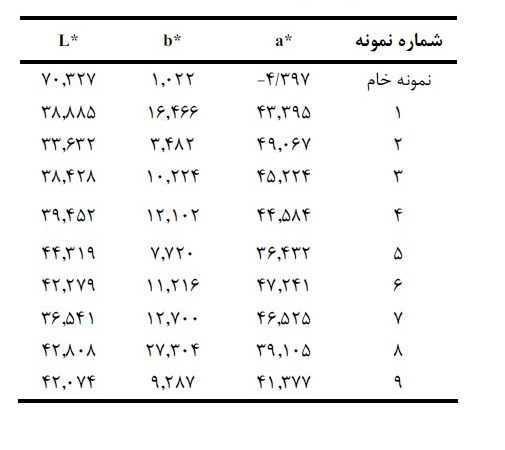
The article reports greater redness (a*) and lower lightness (L*) for samples with stronger colour. Sample 2 had the highest reported K/S, 25.75, while sample 5 had the lowest, 6.60. These values refer to the tested samples and measurement conditions.
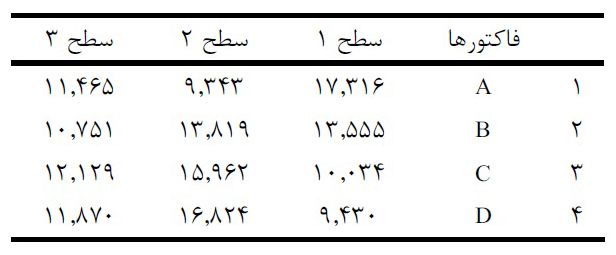
The reported optimum combination was A1–B2–C2–D2: two hours of ultrasound, twelve hours of soaking, aniline as the swelling agent, and 10% pigment relative to leather mass. The source associates this combination with stronger colour and less streaking within its experimental design. It is not a universal optimum for other leathers, pigments or equipment.
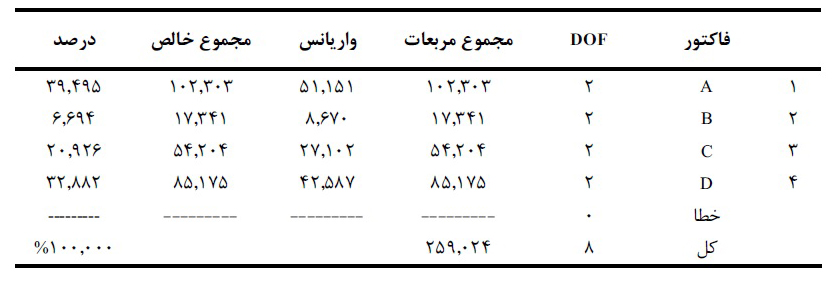
The analysis of variance assigned approximately 39.495% of the reported contribution to ultrasonic treatment time, 32.882% to pigment dosage and 6.694% to soaking time. Treatment duration was the most influential factor in this model, while soaking time contributed the least of the four selected factors.
Most tested samples were reported to have lightfastness ratings of 6–7 on a blue-wool scale with a maximum of 8. The source also describes very good washfastness against the grey scale, whose maximum rating is 5, without giving a precise washfastness grade for every sample in the prose.
The article attributes good resistance to washing partly to the pigment’s low water solubility and limited tendency to leave the leather and enter the wash bath. These are the study’s observations; performance depends on the particular sample and test conditions.
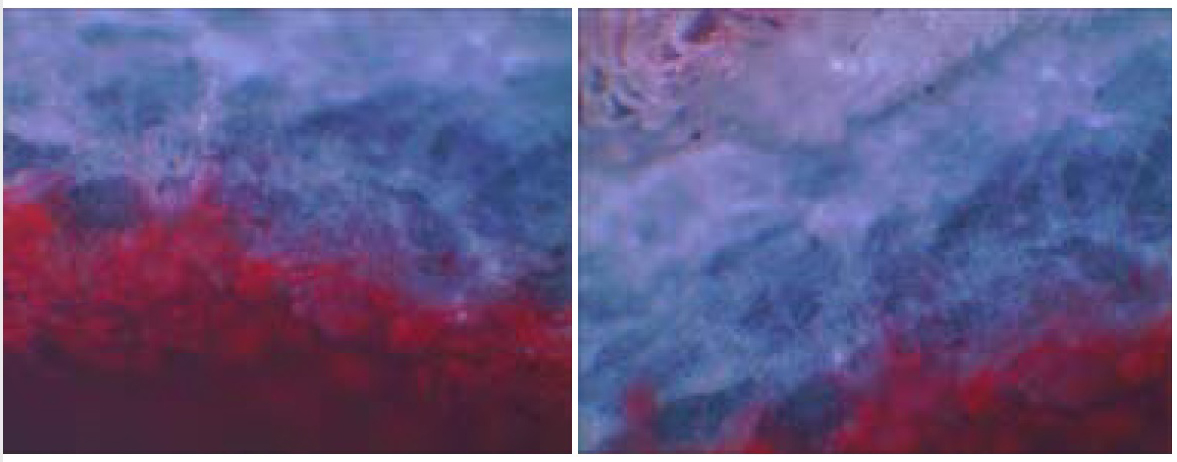
Electron micrographs were used to examine surface deposition and pigment aggregates. Polarising microscopy of a leather cross-section approximately 1 mm thick showed penetration of about 0.1 mm. The central part remained uncoloured. The source suggests that substrate structure and quality, pigment concentration and swelling-agent dosage may help explain the limited depth.
Editorial clarification: the source gives inconsistent aggregate-size units: approximately 200 nm in the discussion and 200 μm in the conclusion. It also contains inconsistent figure references and magnification descriptions. This translation does not choose one of those conflicting statements as a verified measurement. The original research publication should be checked before using those details quantitatively.
Within the reported experiment, ultrasound improved the optical colour-strength response and the selected treatment produced a stronger red appearance. However, microscopy showed a largely surface-focused effect with shallow pigment penetration. Stronger colour therefore did not establish complete through-colouring of the tested leather.
The study is useful as an example of experimental design and the distinction between surface colour, colour strength, fastness and penetration depth. Before considering scale-up, a leather producer would need to validate the substrate, chemicals, equipment and resulting performance for the intended application.
Did ultrasound colour the leather all the way through?
No. The reported cross-section showed about 0.1 mm penetration in leather approximately 1 mm thick, with an uncoloured core.
What did K/S represent in this study?
It was the optical colour-strength response used to compare treatments and optimise the selected factors.
Is the reported optimum a ready-to-use factory recipe?
No. It describes the selected laboratory conditions in this historical study; it does not establish suitability for another production process.
Research attributed in the Persian article to Bashir Katouzian (textile engineering, Science and Research branch; Young Researchers Club, Shahr-e Rey), Amir Kiomarsi (organic colour materials research, Institute for Color Science and Technology, Tehran) and Abousaeid Rashidi (textile engineering, Science and Research branch, Islamic Azad University, Tehran). Name spellings here are transliterations from the Persian source.
For a related business perspective, read market orientation and innovation in new leather products. To discuss material requirements, use the Dalir contact page.