
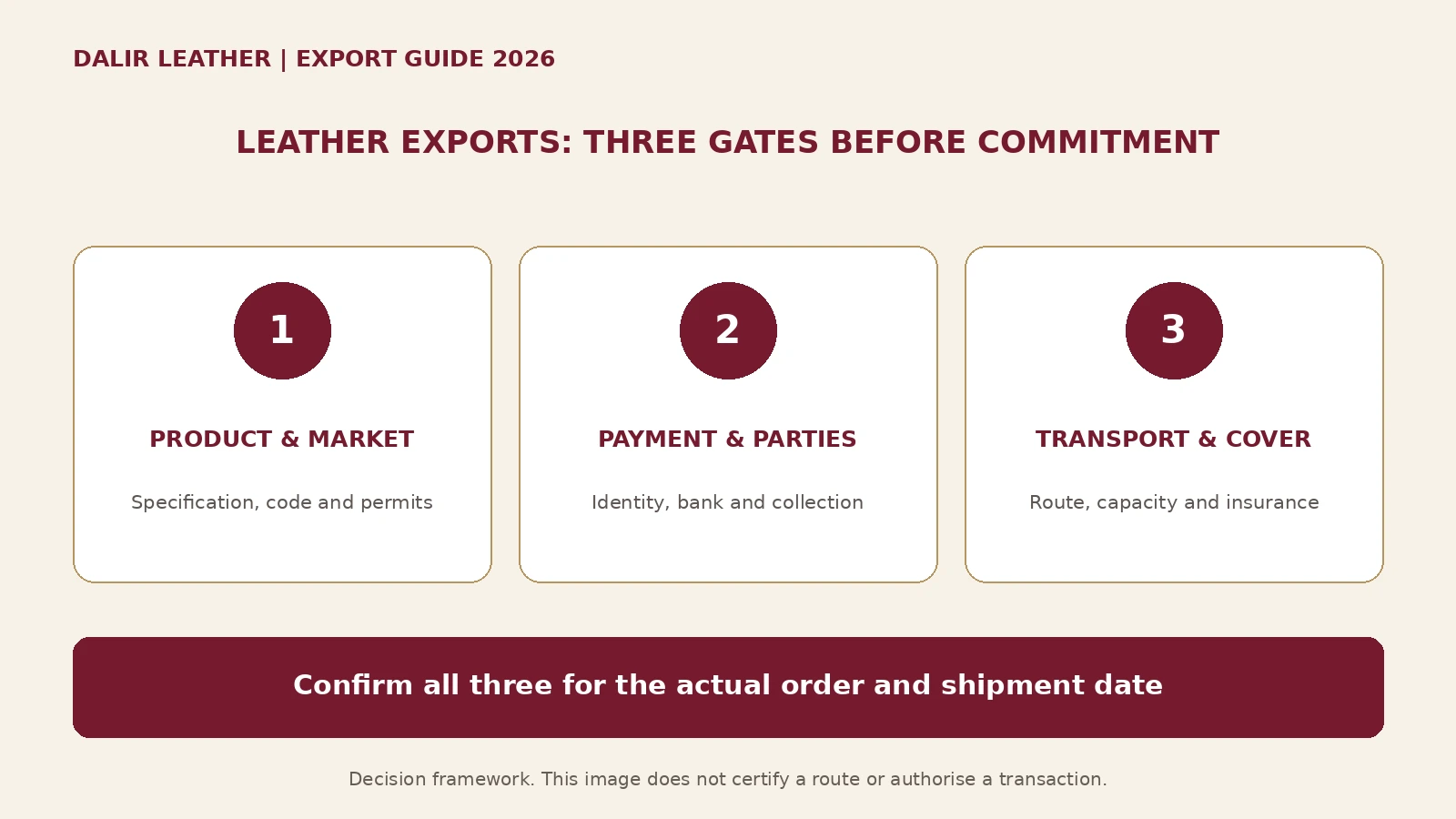
Quick answer: A high selling price alone does not make a leather export market viable. Before committing, verify lawful entry, a credible buyer, a lawful payment route, and acceptable transport and insurance for the individual transaction.
Prepared by Dalir Leather Industry | Sources reviewed: 23 October 2026. This practical guide is based on the supplied report and checked sources. It supports initial decisions; it does not establish every country’s tariff or live border availability.
In this guide: Getting started | HS classification | Markets | Sanctions and payment | Shipping | Quality | Documents | Pricing | Action plan | FAQ | Sources
Detailed sections: Product stage | Country coverage | Market details | Route scenarios | Party screening | Quotation terms | Product dossier | Packaging and insurance | Contingency | Release checklist
Specify whether you sell raw hides, wet-blue, crust or finished leather. Record the animal species, surface finish, thickness, area, colour and grading in a technical sheet. Our guide to natural leather explains material and finish differences. An approved sample followed by a trial order is this guide’s practical starting approach, rather than a promise of demand or sales.
| Product group | Possible heading | What to verify |
|---|---|---|
| Raw bovine and equine hides | 4101 | Condition, health requirements and export duties |
| Raw sheep and lamb skins | 4102 | Health documentation and preparation |
| Other raw hides and skins | 4103 | Species and possible CITES requirements |
| Tanned or crust bovine and equine leather | 4104 | Wet-blue or crust and processing stage |
| Tanned or crust sheep and other animal leather | 4105 / 4106 | Species, tanning and condition |
| Further-prepared bovine and equine leather | 4107 | Surface and finishing |
| Further-prepared sheep and other animal leather | 4112 / 4113 | Species and national subheading |
| Chamois, patent and metallised leather | 4114 | Match the legal heading definition |
| Composition leather and relevant leather waste | 4115 | Actual material and waste characteristics |
These are heading families, not a binding tariff determination. A customs specialist should confirm national codes in Iran and the destination against the actual specifications. Finished bags, shoes and other articles do not necessarily belong to Chapter 41. Check current Iranian export restrictions, duties and permissions separately.
This table is a strategic screening analysis based on the source report. It is not measured demand data or proof that sales are permitted. Countries grouped together still have different laws; assess each destination and buyer separately.
| Country or market group | Potential to investigate | First checks |
|---|---|---|
| Turkey | Footwear, bags and leather garments; an initial screening candidate | National tariff, buyer and bank acceptance, and road-route availability |
| UAE and Oman | Regional distribution and possible re-export | Final destination, origin rules, banking and transport; transit does not change Iranian origin |
| Iraq and the Kurdistan Region | Nearby buyers and smaller trial orders | Buyer credit, collection risk and crossing operations |
| Armenia, Azerbaijan and Georgia | Regional access and smaller markets | Actual demand, transit, tariffs and counterparty checks |
| Pakistan and Afghanistan | Proximity and potential industrial users | Border security and operations, documentation and lawful settlement |
| India and Bangladesh | Large footwear and leather-goods industries | Price competition, specifications, import permissions and logistics |
| China, Vietnam and Indonesia | Industrial consumption and standardised orders | Order scale, consistent quality, shipping and payment |
| Thailand, Malaysia, South Korea and Japan | Selective specialist customers | Traceability, consistency and market-access costs |
| Italy, France, Spain, Portugal and Germany | Speciality leather and higher-value applications | Sanctions, banking, chemical requirements and importer acceptance |
| Other EU markets, UK and Switzerland | Case-by-case specialist buyers | Separate legal regimes; do not apply EU rules automatically elsewhere |
| Russia, Belarus and Central Asia | Opportunities depending on buyer and product | Counterparty and bank sanctions, transit and collection risk |
| Saudi Arabia, Qatar, Kuwait and Bahrain | Specific distributors or industrial buyers | Commercial access, customs, banking and verified demand |
| Egypt, Morocco, Tunisia and Algeria | Footwear and leather industries | Tariffs, importer status, import rules and freight |
| South Africa, Kenya, Nigeria and other African markets | Project-based or individual opportunities | Importer reliability, settlement and transport costs |
| United States | A heavily restricted market | Broad prohibition on Iranian-origin imports with limited exceptions; specialist review before offering |
| Canada | Independent case-by-case assessment | Check Canadian rules separately; do not treat the US regime as Canadian law |
| Brazil, Mexico, Argentina and other Latin American markets | Individual buyers competing with local supply | Distance, tariffs, freight and banking |
| Australia and New Zealand | Distant specialist markets | Import and biosecurity conditions, samples and shipping costs |
The Council of the EU reports the reimposition of nuclear-related restrictions in September 2025 alongside financial and transport restrictions. That does not by itself establish whether every leather transaction is allowed or prohibited. Review the goods, beneficial owners, banks, intermediaries, carriers and insurers under applicable rules. See the Council’s official Iran sanctions page.
US rules broadly prohibit Iranian-origin imports, subject to limited exceptions; consult OFAC’s Iran programme and obtain specialist advice before offering to that market. Canada and other jurisdictions have separate rules. Routing through another country does not change the true origin. Keep origin, documents and payment arrangements transparent, and obtain written confirmation of the lawful payment route before an irreversible commitment.
Lloyd’s List Intelligence’s 22 October 2026 brief reports 104 non-Iranian-linked transits through Hormuz during 5–11 October and increasing attacks. It also describes restrictions affecting Iranian ports. Strait traffic therefore does not demonstrate access for Iranian export cargo. See the dated maritime brief.
| Mode | Potential use | Before handing over cargo |
|---|---|---|
| Road | Neighbouring markets or permitted transit routes | Operational crossings, transit permits, liability and insurance |
| Sea | Larger quantities where the route is accepted | Iran-origin acceptance, port access, restrictions, war-risk cover and storage costs |
| Air | Small, time-sensitive samples | Actual flight, cargo acceptance, operator restrictions and insurance |
| Multimodal | Route diversification where lawful | Transit customs, handling costs and responsibility for damage |
The EASA advisory for Iran’s airspace identifies high risks. Open airspace alone is not proof of an available cargo service. Record the quotation date, validity, permitted alternative route, and cancellation or hold terms. Obtain carrier and insurer acceptance for the actual shipment.
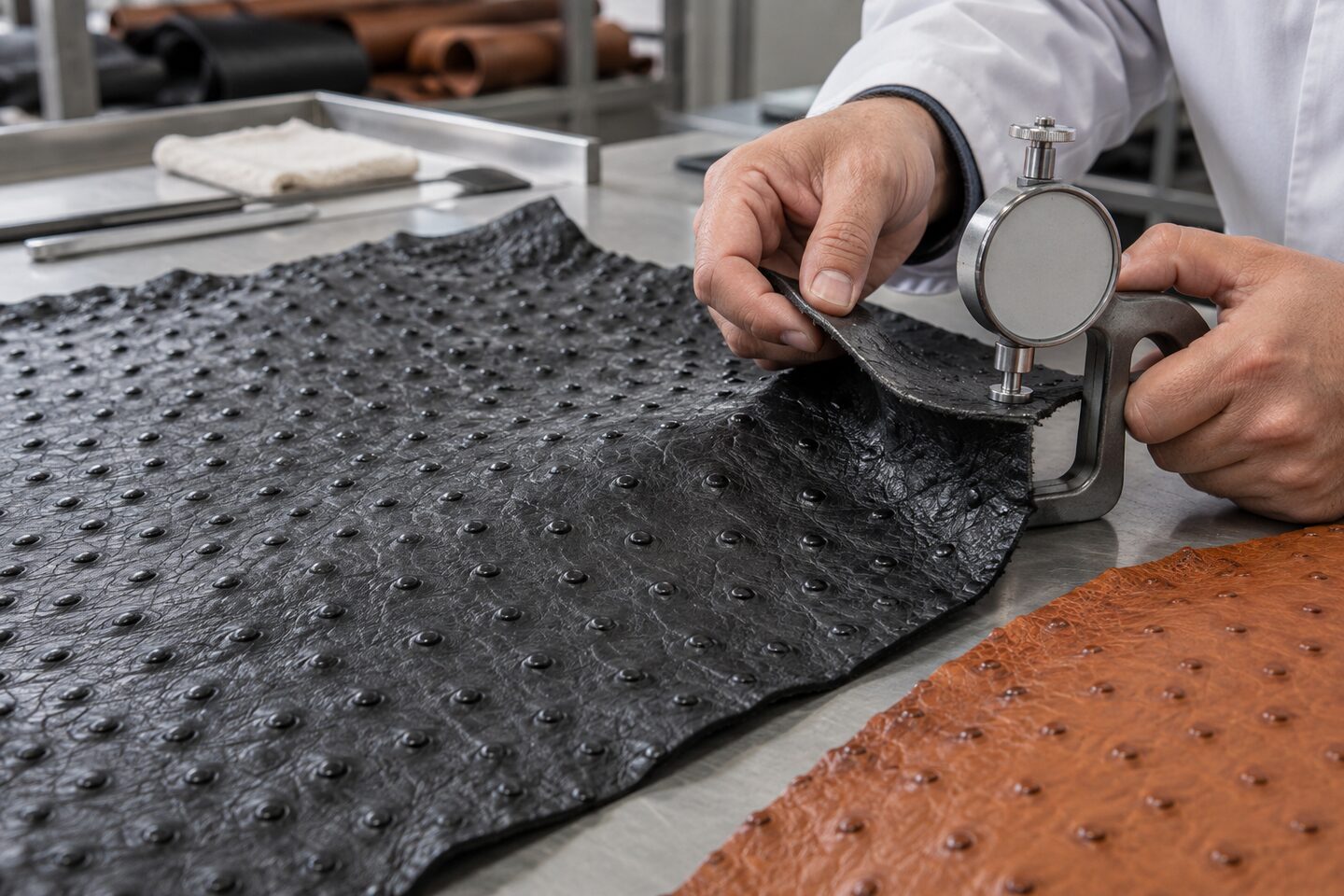
Record species, tanning, average thickness and tolerance range, colour, finish, area and defect grade for each lot. Agree tensile strength, tear strength, colour fastness, finish adhesion and restricted-substance tests according to the application and contract. Follow our pre-shipment leather quality-control checklist for practical inspection steps.
The EU chromium VI rule prohibits placing skin-contact leather articles or relevant leather parts on the market at concentrations equal to or above 3 mg/kg of dry leather. Do not extend that statement to every material or application without checking scope. Read the legal restriction.
On 13 July 2026, the Commission announced adoption of a delegated measure removing cattle hides, skins and leather from EUDR scope. Its announcement also described Parliament and Council scrutiny before entry into force. The announcement alone does not establish the final legal position today; check the applicable text for the transaction. See the Commission update. Check CITES by scientific species and origin where relevant. A crocodile emboss on cowhide is not itself crocodile-species leather.
1) Define the product and HS code. 2) Check Iranian and destination rules and all relevant parties. 3) Obtain approval of samples and technical specifications. 4) Issue a pro forma stating currency, quantity, quality, tolerances, validity, delivery, inspection and dispute terms. 5) Obtain written payment, transport and insurance acceptance before committing.
6) Prepare the commercial invoice, packing list, certificate of origin, customs declaration and transport document; add health, laboratory or species documents where required. 7) Check lot identification, weight, area and moisture-resistant packaging. 8) Retain settlement records for applicable Iranian foreign-exchange and tax obligations. State Incoterms 2020 with a precise named place; Incoterms do not replace payment or dispute provisions.
Cost basis: allocated production + packaging + freight and formalities under the chosen delivery term + insurance + finance + waste and returns allowance + delay allowance + target profit. Avoid charging a cost twice when the delivery term allocates it to the customer.
The source report’s hypothetical example uses $19 production, $2 freight and formalities, and $1.50 collection and risk costs per square metre: $22.50 total. A 20% markup on cost gives $27; this is not a 20% margin on sales. These are illustrative figures, not market prices. Our wholesale leather pricing guide explains usable area and cutting yield. Align quotation validity and delivery conditions with cost volatility and available transport.
| Suggested period | Action | Target output; not guaranteed |
|---|---|---|
| 30 days | Select five products, prepare samples and specifications; identify 30 buyers in three markets | Bilingual catalogue and an initial compliance file |
| 90 days | Evaluate ten serious buyers, obtain bank and freight checks, send samples by a permitted route | Three valid proposals and an attempt at a trial order |
| 180 days | Execute small orders and measure profit, delays and quality | A repeatable process and profit dashboard for selected markets |
Prepare the leather type, thickness, colour, finish, quantity and destination. For textured surfaces, explore Dalir’s leather printing and embossing samples. Use our contact page to discuss supply and cooperation. Export feasibility, price and delivery timing are assessed separately for each order.
The underlying research recommends evaluating products with higher value per unit of weight, measurable specifications and a defined industrial buyer. This is a business assessment, not a promise that crust or finished leather will always be more profitable. Compare actual factory costs, freight, possible export duties, deterioration and the financing period for each order.
| Product | Main checks | Factory decision |
|---|---|---|
| Raw and pickled hides | Veterinary controls, preservation, species and potential export duties | Confirm permissions and exit costs for the exact classification before quoting. |
| Wet-blue | Weight, moisture, packaging, tanning consistency and freight cost | Test margin against cost per kilogram and possible delays. |
| Crust | Dyeing suitability, thickness, usable area and customer specifications | Approve a reference sample and specification sheet before production. |
| Finished leather | Finish, colour, fastness, defects, end-use tests and restricted substances | Link added value to repeatable quality and repeat orders. |
| Leather from particular species | Scientific name, origin, species permits and destination rules | Check CITES and national requirements before accepting an order. |
This list preserves the geographic coverage of the research. It is not an official risk rating, a list of permitted destinations or evidence of measured demand. Inclusion is not a recommendation to trade. Check Iranian law, destination rules, transit jurisdictions and the parties to the particular transaction. Hong Kong and Macao may require separate customs analysis. Iran is the origin in this guide.
| Region | Countries and territories covered |
|---|---|
| West Asia and Caucasus | Türkiye, Armenia, Azerbaijan, Georgia, Iraq, Afghanistan, United Arab Emirates, Oman, Saudi Arabia, Qatar, Kuwait, Bahrain, Jordan, Cyprus, Palestine, Lebanon, Syria, Yemen and Israel |
| Central Asia and EAEU | Russia, Belarus, Kazakhstan, Kyrgyzstan, Uzbekistan, Turkmenistan, Tajikistan and Mongolia |
| South Asia | India, Bangladesh, Sri Lanka, Nepal, Bhutan, Maldives and Pakistan |
| East and Southeast Asia | China, Vietnam, Indonesia, Malaysia, Thailand, Cambodia, Japan, South Korea, Singapore, Philippines, Brunei, Laos, Timor-Leste, Myanmar and North Korea |
| European Union | Italy, Spain, Portugal, Germany, France, Netherlands, Belgium, Austria, Ireland, Denmark, Sweden, Finland, Greece, Poland, Czechia, Slovakia, Hungary, Romania, Bulgaria, Croatia, Slovenia, Estonia, Latvia, Lithuania, Luxembourg and Malta |
| Other Europe | Serbia, Bosnia and Herzegovina, Albania, Montenegro, North Macedonia, Moldova, United Kingdom, Switzerland, Norway, Iceland, Liechtenstein, Andorra, Monaco, San Marino, Vatican City, Kosovo and Ukraine |
| North Africa | Egypt, Morocco, Tunisia, Algeria, Mauritania, Libya and Sudan |
| West Africa | Nigeria, Ghana, Côte d’Ivoire, Senegal, Benin, Togo, Burkina Faso, Guinea, Guinea-Bissau, Gambia, Sierra Leone, Liberia, Cabo Verde, Mali and Niger |
| East and Central Africa | Ethiopia, Kenya, Tanzania, Uganda, Rwanda, Burundi, Djibouti, Eritrea, Comoros, Mauritius, Seychelles, Madagascar, Republic of the Congo, Gabon, Cameroon, Chad, Central African Republic, Equatorial Guinea, São Tomé and Príncipe, Somalia, South Sudan and Democratic Republic of the Congo |
| Southern Africa | South Africa, Angola, Zambia, Zimbabwe, Mozambique, Malawi, Botswana, Namibia, Lesotho and Eswatini |
| South America | Brazil, Argentina, Colombia, Peru, Chile, Uruguay, Paraguay, Bolivia, Ecuador, Guyana, Suriname and Venezuela |
| North and Central America | Mexico, Canada, Guatemala, Honduras, El Salvador, Nicaragua, Costa Rica, Panama, Belize, Haiti and United States |
| Caribbean | Cuba, Dominican Republic, Jamaica, Trinidad and Tobago, Bahamas, Barbados, Antigua and Barbuda, Dominica, Grenada, Saint Kitts and Nevis, Saint Lucia and Saint Vincent and the Grenadines |
| Oceania | Australia, New Zealand, Fiji, Papua New Guinea, Samoa, Tonga, Vanuatu, Solomon Islands, Kiribati, Tuvalu, Nauru, Palau, Micronesia and Marshall Islands |
Türkiye can be an industrial market and a possible transit corridor. Check the buyer, GTIP classification, customs and possible additional duties, and payment acceptance separately from whether a truck can cross. Bazargan–Gürbulak, Norduz and Caucasus corridors are geographic options, subject to the carrier confirming the actual loading date and itinerary. Azerbaijan, Armenia and Georgia have distinct rules; transit importance does not establish domestic demand.
The Iran–EAEU free trade agreement entered into force on 15 May 2025. Russia, Belarus, Kazakhstan, Kyrgyzstan and Armenia are EAEU members; Uzbekistan, Turkmenistan and Tajikistan are not. Eligibility for a preference depends on the product schedule and origin rules. Consult the agreement and official implementation-date report. A tariff preference does not resolve banking or sanctions restrictions.
For Iraq, confirm the destination, importer and procedures at the actual crossing. For Afghanistan, assess trial orders with buyer checks and explicit collection terms; proximity does not mean low credit risk. A Czech embassy notice dated 19 October 2026 reports the temporary suspension of border trade and movement from 18 October, especially at Taftan and Gabd–Rimdan. Treat this as a dated alert, not a permanent rule: reconfirm reopening and cargo acceptance before dispatch. Official border notice.
The UAE and Oman may be assessed for genuine buyers or distributors, but the existence of a port or intermediary does not establish acceptance of Iranian cargo. Disclose the route, final destination, origin and beneficial parties. Jebel Ali lies inside the Gulf; Khor Fakkan, Fujairah and Sohar have different geographic positions. Maersk’s 13 October notice announces the specific FM1 relaunch to Khor Fakkan while retaining cargo-acceptance restrictions. It does not confirm direct service from Iran. Official service notice. Assess Saudi Arabia, Qatar, Kuwait and Bahrain separately; a regional headline duty is not the tariff for the actual product.
For China, India, Vietnam, Bangladesh, Indonesia, Thailand and other industrial markets, order scale and consistency between lots matter alongside price. Obtain the buyer’s material specification, permitted shade and thickness variation, tests and delivery plan. Check duties, taxes and entry conditions against the destination’s national code. For Japan and South Korea, agree on bank acceptance, traceability and acceptable laboratory reports before sending samples. An inbound China–Iran container quote cannot be treated as a quote for exports from Iran or the reverse journey.
For Italy, France, Spain, Portugal and Germany, make a product-specific offer: species, finish, selection, thickness, average size and reproducibility. Commercial interest does not establish payment feasibility. Check TARIC or Access2Markets using the CN code and origin; one rate cannot describe all of Chapter 41. Assess the UK and Switzerland under their own rules. For a specialist buyer, an approved sample and buyer-accepted tests are more useful than an undefined promise of “export quality”.
In Egypt, Morocco, Tunisia and Algeria, assess the industrial importer and total access cost. In sub-Saharan and distant markets such as Ghana, Kenya, Nigeria and South Africa, do not dispatch speculative stock without a buyer and a clear collection structure. Brazil, Mexico and Argentina have local producers; the Iranian sample needs a demonstrable advantage. Canada, Australia and New Zealand require separate import, biosecurity and banking analysis. Treat US origin restrictions seriously; Israel and North Korea are not routine sales-development destinations without the relevant legal review.
The ranges below are scenario estimates from the underlying research for planning. They are not carrier quotations, guaranteed transit times or confirmation that a route is operational on 23 October. Separate driving time from border queues, customs, transfers and final delivery. An air transit estimate starts only after actual cargo acceptance and uplift.
| Destination | Geographic scenario | Illustrative calendar days; not guaranteed |
|---|---|---|
| Türkiye | Bazargan–Gürbulak | 5–25 |
| Armenia | Norduz | 3–8 |
| Georgia | Transit via Armenia | 5–12 |
| Iraq | Crossing suitable for the destination | 2–7 |
| Afghanistan | Dogharun or Milak as applicable | 3–10 |
| Turkmenistan | Sarakhs or a confirmed crossing | 4–10 |
| Uzbekistan and Tajikistan | Transit through Turkmenistan | 7–18 |
| Kazakhstan | Turkmenistan or Caspian route if accepted | 8–20 |
| Russia | Caucasus, Azerbaijan or Caspian route if accepted | 10–25 |
| Central Europe | Transit through Türkiye into the EU | 12–30 |
No firm transit time is given for Pakistan: verify resolution of the border disruption first. For distant destinations, assess hub connections, onward bookings and transshipment separately. A road-to-foreign-port or road-to-foreign-airport option requires lawful transit, Iranian-origin cargo acceptance, an acceptable operator and insurance. Passing through a hub does not change origin.
The OFAC determination effective 1 October 2026 identifies Iran’s automotive and rail sectors under Executive Order 13902. Do not simplify this into “every rail movement is prohibited for everyone”: assess the operator, wagon owner, terminal, bank, insurer and applicable jurisdiction. Air freight may be considered for samples or higher-value leather, subject to specific capacity and acceptance. An EASA notice is not a cargo operator’s acceptance.
| Cost component | What the quotation should specify |
|---|---|
| Road | FTL or LTL, itinerary, border waiting, transit and delivery |
| Sea | Freight, terminals, transshipment, emergency surcharges and war-risk cover |
| Air | Chargeable weight, fuel, security, handling and accepted capacity |
| Rail | Wagon or container, terminals, transfers and party screening |
| Multimodal | Each leg’s cost, transfer of responsibility and insurance exclusions |
A short freight-quote validity, for example 24–72 hours, is a proposed contract policy rather than a market rule. Obtain actual quotations. Separate freight from the goods price, recording the route, operator, chargeable weight and validity date. Do not present historical or reverse-direction rates as current prices.
The OFAC determination effective 24 August 2026 identifies Iran’s aviation, digital asset, gold, shipping and technology sectors under Executive Order 13902. Together with the rail-sector change, this increases the importance of assessing the service chain. The goods description alone does not determine a transaction’s legal status. Cryptocurrency, an intermediary or a third-country account does not guarantee exemption from sanctions.
For a new customer, assess deposits and a balance linked to inspection or shipping documents under applicable law and commercial risk. Unsecured open-account sales without a collection history increase the exporter’s exposure. Letters of credit, documentary collection and escrow are useful only if the actual bank or provider accepts the transaction. Third-country escrow must transparently disclose and accept Iranian origin and the real beneficiary. False invoices, misdeclaration, fabricated origin and concealed ownership are not acceptable solutions.
Exchange rates, chemicals, energy, wages and freight can invalidate a long fixed-price offer without cost protection. Assess the factory’s replacement costs and cash flow instead of treating a headline inflation figure as an order-specific cost. A short goods-price validity, such as 3–7 days for a first order, is a management proposal to agree with the customer and production team.
| Pro forma term | Required details |
|---|---|
| Goods and quality | Species, processing stage, colour, thickness and tolerance, area, grade and reference sample |
| Price and currency | sqft or m² unit, receivable currency, profit basis and validity |
| Lead time | Define commencement after received deposit and sample approval, with explicit suspension rules |
| Delivery term | Use a suitable Incoterms 2020 rule with a named place. FCA may suit road scenarios; FOB is for sea or inland-waterway transport. |
| Freight and insurance | Capacity conditions, border-waiting charges, rerouting and insurance scope |
| Disruption | Agreed suspension, cancellation, alternative routes, extensions and refunds |
| Compliance and documents | Consequences of bank, operator or insurer refusal and responsibility for checks |
Before quoting, check the commercial card, permissions, duties and export-proceeds obligations against current Iranian rules and the exporter’s own file. Do not apply a temporary percentage universally. Retain the invoice reference, customer identity, payment chain and evidence needed to discharge obligations. Establish banking acceptance and currency-obligation feasibility before production.
“Product passport” here means a proposed internal dossier, not a claim of a new mandatory certificate. Prepare a dossier for each leather family and link the approved revision to the reference sample and contract:
Agree the test method, acceptance limit, sampling date and laboratory with the buyer. Do not assume raw or partly processed hides have the same veterinary and health-certificate treatment as finished leather. For CITES-listed species, the appendix, origin and transaction determine the required export/import permits or re-export certificate. Official CITES guide. A python or crocodile pattern embossed onto bovine leather does not change the base animal species.
For finished leather, assess moisture, mould, dye transfer, creasing and uneven pressure. Test rolls versus flat packs, protective layers and moisture control against the actual finish; absorbents must not damage the surface. Align package and packing-list descriptions, species, lot, shade, grade, count, area, weight and true origin. Design for possible extended storage, not only driving time.
“Cargo insured” is insufficient. Establish the actual route, transshipment, temporary storage, border waiting, war exclusions, insured value, deductible and claims procedure. Insurance responsibility depends on the delivery rule and contract. Verify real cover before dispatch even when the buyer arranges it. CIF and CIP have different insurance obligations, and the chosen term must fit the transport mode.
| Event | Contractual and operational response |
|---|---|
| Border congestion | Apply agreed waiting limits and cost allocation; assess alternatives only after written acceptance. |
| Border closure or port refusal | Hold loading; agree a new route or delivery date with the buyer. |
| Flight cancellation | Reconfirm replacement capacity or a lawful multimodal option. |
| Payment rejection | Check a pre-approved lawful banking alternative or stop the transaction; do not conceal the beneficiary. |
| Insurance or war-cover refusal | Assess acceptable alternative cover or routing; do not dispatch without agreed protection. |
| Quality failure | Hold the lot; document the cause, correction, resampling and buyer acceptance. |
| Additional document request | Complete the permit, inspection or certificate before release. |
The research’s practical conclusion is to assess market, money and movement together. A high nominal margin with uncertain collection or transport may be unsuitable for the factory. A small start with a defined product and assessable customer matters as much as expanding the list of markets.
Each transaction needs four separate checks: lawful market entry, permitted counterparties, a lawful payment route, and acceptance by carriers and insurers. This guide does not approve a transaction or guarantee an available route.
A nearby market with a verified buyer and a small trial order is a practical screening option. Turkey and other neighbours are candidates for investigation; the final choice depends on the product, total costs, banking and an actual transport route.
The reviewed evidence does not establish that. Strait traffic or open airspace does not prove that your shipment from Iran will be accepted. Obtain written acceptance for the specific cargo and route.
Commercial invoices, packing lists, certificates of origin, customs declarations and transport documents are common starting points. Veterinary, laboratory or CITES documents depend on the product, species and destination rules.
For leather articles and leather parts in contact with skin, chromium VI at or above 3 mg/kg of the leather’s dry weight triggers the relevant market-placement prohibition. Agree raw-material specifications and testing with the importer.
Add production, packaging, transport, insurance, finance, waste and risk allowances, then apply a clearly defined profit target. The article’s numerical example is educational and is not a market quotation or a Dalir Leather offer.
No. Check the exact product line, concession schedule and rules of origin. A tariff preference does not establish banking acceptance or permission for every party.
No. They are scenario estimates from the research for planning. Confirm the actual order’s booking, capacity, border conditions and delivery time separately.
Clarify the actual route, transshipment, border waiting, temporary storage, war cover and exclusions, insured value, deductible and claims procedure.
It is a proposed internal dossier covering species, origin, processing stage, thickness, size, grade, colour, finish, tests, lots and sample photos; it is not a new statutory certificate.
Hold execution while assessing a lawful, pre-approved alternative or an agreed contract change. Fabricated origin or concealed beneficiaries are not acceptable solutions.
Council of the EU: Iran sanctions
OFAC: Iran sanctions programme
Lloyd’s List Intelligence: Hormuz brief, 22 October 2026
EASA: Airspace of Iran advisory
EUR-Lex: Regulation 301/2014 on chromium VI
European Commission: EUDR scope update, 13 July 2026
Content basis: the full research “A comprehensive practical guide to exporting natural leather from Iran under war, sanctions and transport disruption”, dated 23 October 2026. The web edition has been expanded with product, country and operational details.
Additional sources: OFAC: 2026 rail determination | OFAC: August 2026 sectors | EAEU–Iran agreement | EAEU implementation report | Pakistan border notice, 19 Oct 2026 | Maersk FM1 notice, 13 Oct 2026 | CITES permit framework