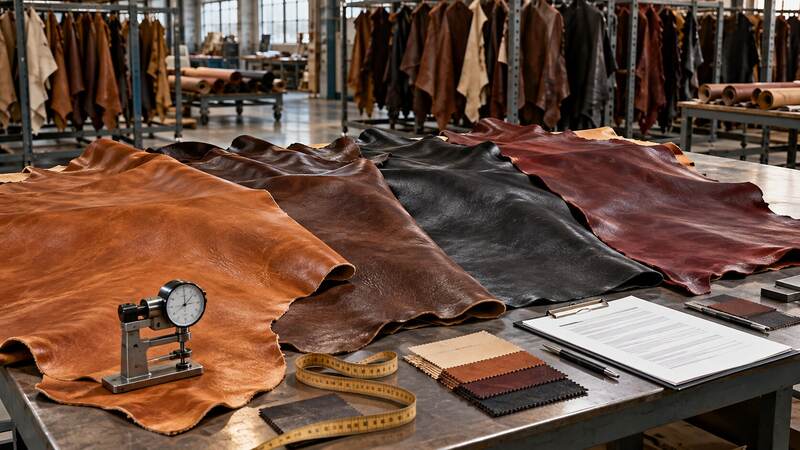
The wholesale price per square foot is only the starting point. Two leathers with a similar quoted price can produce very different material costs because grade, thickness, hide size, defects, finish and cutting yield are not the same. This guide explains how professional buyers compare quotations and calculate the true cost of usable leather.
True cost per usable square foot = Total landed cost ÷ Actual usable cutting area
For example, leather quoted at $2.00 per square foot with an 80% cutting yield effectively costs $2.50 for each usable square foot before cutting labour. This is why an experienced buyer evaluates yield, defect location and delivery costs alongside the invoice price.
Cow, calf, goat, sheep and ostrich skins differ in fibre structure, size, thickness, strength and end use. Within the same species, breed, age, origin, season and raw-hide preservation can also affect the quality and cost of the finished leather.
A higher selection normally provides a larger clean cutting area. The location of defects matters as much as their number. Scars, tick marks, holes, flay cuts and tanning defects located in the centre of a cutting panel can reduce yield more than defects near the edge. Ask the supplier to define the grade, selection mix and allowable defects in writing.
Raw hide, wet-blue, crust, dyed crust and finished leather carry different levels of added value. Retanning, dyeing, fatliquoring, drying, softening and finishing add conversion costs. Chrome, vegetable, chrome-free and combination tannages also require different materials, processing times, tests and quality controls.
A leather specified at 1.2-1.4 mm is not equivalent to leather with the same nominal thickness but poor uniformity. The measuring point and permitted tolerance should be included in the purchase specification. Splitting, shaving and thickness control are part of the production cost.
Light or custom colours, sample matching, batch-to-batch consistency and dye penetration may require additional work. Aniline, semi-aniline, pigmented, milled, patent, waxed, embossed and water-resistant finishes each have different material and processing requirements. For repeat orders, approve a master sample and document an acceptable colour tolerance.
Larger hides may suit large panels, but size alone does not guarantee a better yield. The most economical selection is determined by a cutting trial using the buyer’s real shoe, bag, belt or garment patterns. The useful measure is the number of acceptable components cut from each hide, not simply the marked area.
Small orders spread colour development, machine setup, sorting and packing costs over less material. A sample lot or a small custom colour therefore cannot always be priced like a production order. Request price breaks for several quantities, such as 500, 2,000, 5,000 and 10,000 square feet.
An ex-tannery price is not the same as a landed price. Protective wrapping, pallets or cartons, moisture control, freight, insurance, banking fees and customs-related costs should be shown separately. For export orders, the agreed Incoterm and the responsibilities of both parties must be clear on the quotation.
Supplier A quotes $3.00 per square foot with an 80% cutting yield. Its effective material cost is $3.75 per usable square foot. Supplier B quotes $2.70, but the yield is only 65%, creating an effective cost of approximately $4.15. Supplier B looks 10% cheaper on the quotation, yet it is more expensive in production.
No. A lower-priced leather may have more defects, unsuitable hide sizes or a lower cutting yield, increasing the real material cost per finished component.
Either unit can be used as long as every quotation is converted to the same basis. One square metre equals approximately 10.764 square feet.
Dye type, colour-matching difficulty, coverage, number of finishing stages, batch size and consistency requirements can all change the conversion cost.
Yes. The sample should be assessed for colour, thickness, handfeel, strength, cutting behaviour, stitching performance and yield using the actual product pattern.
A professional buyer should track cost per accepted, usable and net-cut square foot, not only the purchase price. Grade, defects and hide size become yield; colour and finish become conversion cost; and MOQ, lead time, delivery and supplier reliability become landed and risk-adjusted cost. This approach reveals which quotation is truly economical.
Send Dalir Leather your required leather type, end use, thickness, colour, quantity and delivery destination so our team can review production feasibility and quotation terms.