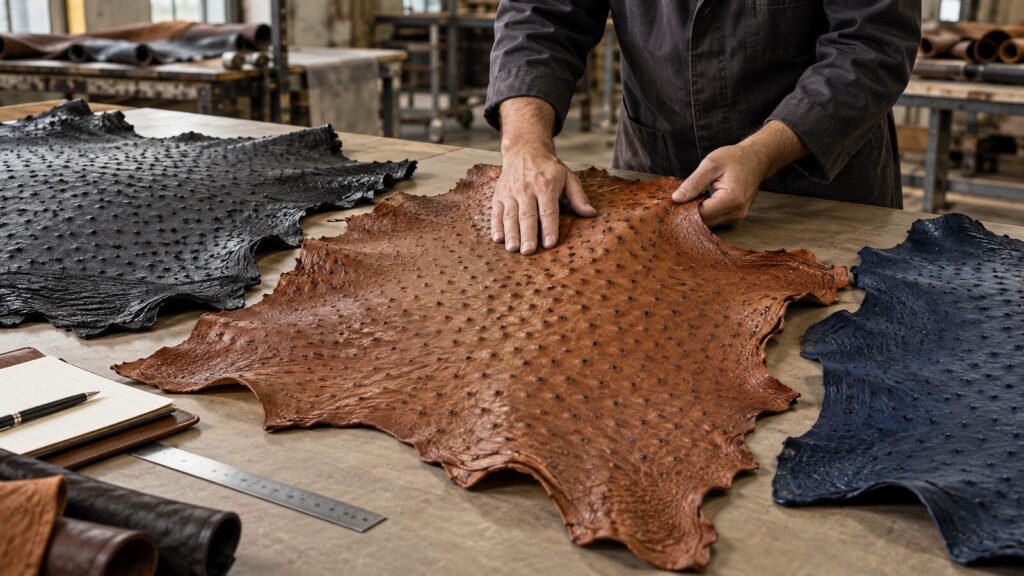
When sourcing ostrich leather in bulk, labels such as “Grade A,” “first grade,” or “export quality” are not enough to make a sound purchasing decision. For manufacturers of bags, footwear, garments, and luxury accessories, the decisive factors are usable cutting yield, defect location, quill pattern consistency, thickness, handle, and color uniformity across the shipment.
This guide explains how ostrich leather is commonly graded, which characteristics affect price and cutting efficiency, and what wholesale buyers should verify before confirming an order.
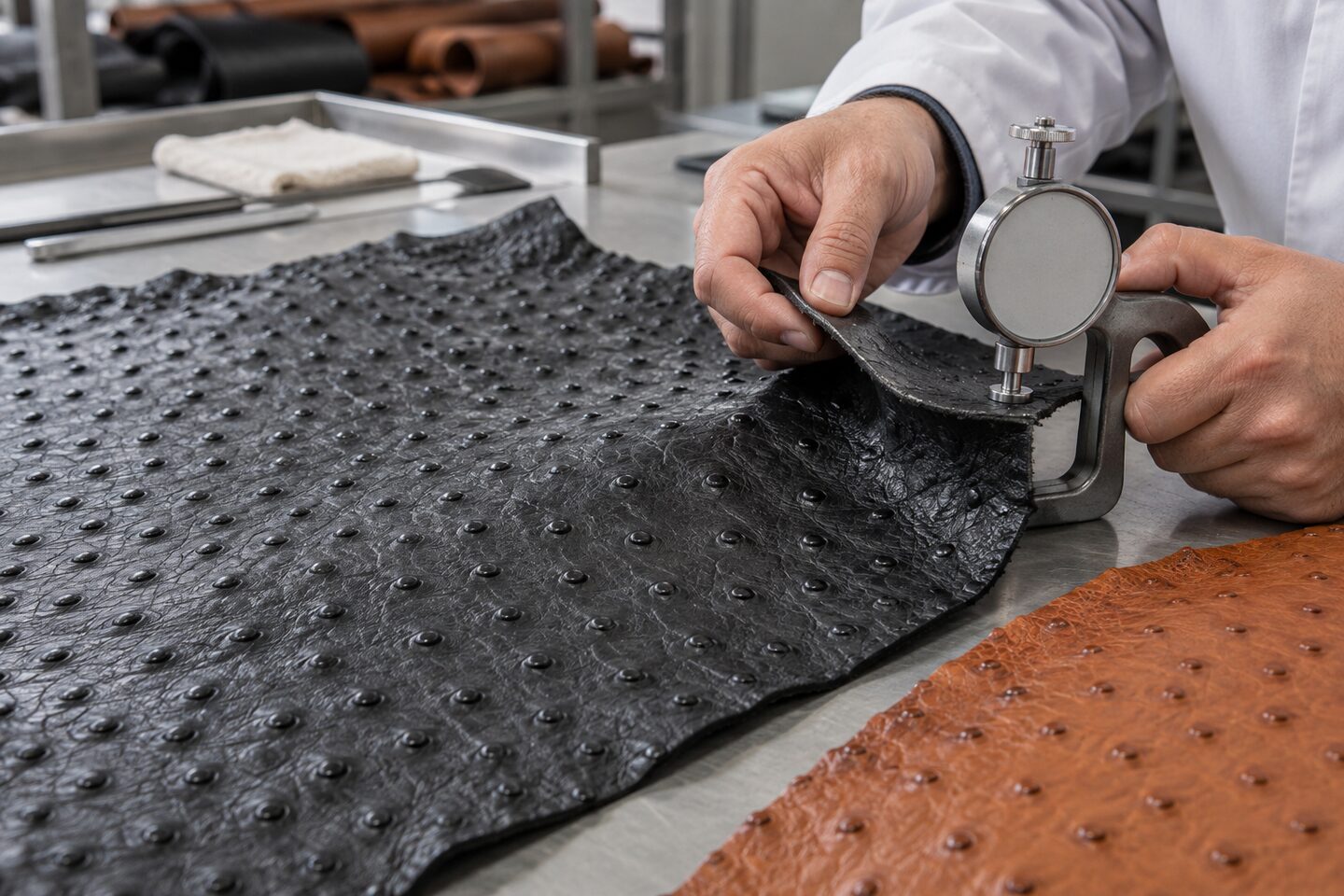
Manufacturing quality refers to tanning, dyeing, and finishing: softness, strength, color fastness, thickness consistency, and surface performance. Grading, on the other hand, mainly indicates how much of a skin is free from significant defects and suitable for cutting the required components.
A lower-grade skin is therefore not automatically poorly tanned. It may have an excellent finish but contain a few scratches or holes that prevent the cutting of one large panel. The same skin may still provide very good yield for wallets, watch straps, patchwork, or smaller footwear components.
The best-known part of an ostrich skin is the central quilled area, commonly called the crown. In one widely used grading approach, the crown is divided into four imaginary quarters, and the number of quarters affected by relevant defects contributes to the grade.
This approach is useful for understanding defect location, but buyers should always request the supplier’s written grade definition. Grade names are not fully standardized across every producer and market. Two suppliers may both use A, B, and C while allowing different types or numbers of defects.
Total skin area is only part of the calculation. A buyer needs to know how much of the crown and surrounding areas can be used for the intended pattern. Defect location becomes more important as pattern pieces become larger. A large handbag requires uninterrupted panels, while wallets and watch straps can be nested around localized defects.
Holes, scratches, scars, bacterial damage, torn edges, and processing marks can reduce yield. A defect close to the edge usually has less impact than one in the center of the crown. Before ordering, request a full-skin photograph together with close-up images of significant defects.
Raised natural quill follicles are the defining visual feature of ostrich leather. Their size, density, and prominence should suit the final product. Good consistency in the central area helps pattern placement and makes finished components easier to match. Natural leather is not mechanically repetitive; limited variation is part of its authenticity.
Two skins with similar nominal area may have different shapes and usable yields. For wholesale production, review not only square footage but also the approximate length and width of the crown and the ability to place the primary pattern. If a cutting pattern is available, provide the dimensions of its largest component to the supplier.
Thickness must match the intended application. Leather that is too heavy may not suit garments or delicate components, while very thin leather may require reinforcement in structured bags or footwear. Do not rely on a single average figure: request an acceptable thickness range and information about variation between the center and edges.
Evaluate the leather while bending it gently and allowing it to recover. The finish should not crack or release color during normal flexing. Gloss level, touch, and finish type should also match the final product; a soft matte surface and a formal high-gloss finish serve different markets.
For export orders and production runs, shade consistency between skins is essential. Lighting, cameras, and screens can distort color perception. An approved physical sample, the producer’s internal color reference, and a defined tolerance for shade variation reduce the risk of disagreement after delivery.
The highest grade is not always the most economical choice. The correct grade depends on pattern size and expected cutting waste:
Before requesting a quotation, send the following information and ask for a written response:
A grade is a useful summary, but it does not describe every production requirement. A higher-grade skin may provide less yield for a particular pattern if its shape, crown dimensions, or defect direction is unsuitable. Purchase orders and pro forma invoices should therefore specify measurable requirements such as thickness, color, usable area, defect position, and an approved reference sample.
For a more accurate technical review, provide the product type, color, finish, thickness, approximate dimensions of the largest component, and expected order volume. Product photographs or cutting patterns can help identify a more efficient skin selection and reduce waste.
You may also read How to Identify High-Quality Ostrich Leather: 8 Essential Checks for Buyers. For wholesale and export inquiries, visit the Dalir Leather English website and contact our team with your technical requirements.
No. Grade names and permitted defects can differ between producers. Request a written grade specification and photographs from the actual lot being offered.
It depends on the application. When pattern pieces are small, localized defects can often be avoided during cutting while still producing defect-free finished goods.
Usable area is more relevant to real production yield. Total area should be assessed together with defect location, crown dimensions, and the size of the required pattern pieces.
The safest method is to approve a physical sample and record it as the production reference. Photographs alone are not reliable enough for final color approval.
Create a buyer account to request samples, review technical specifications, and receive a quotation.